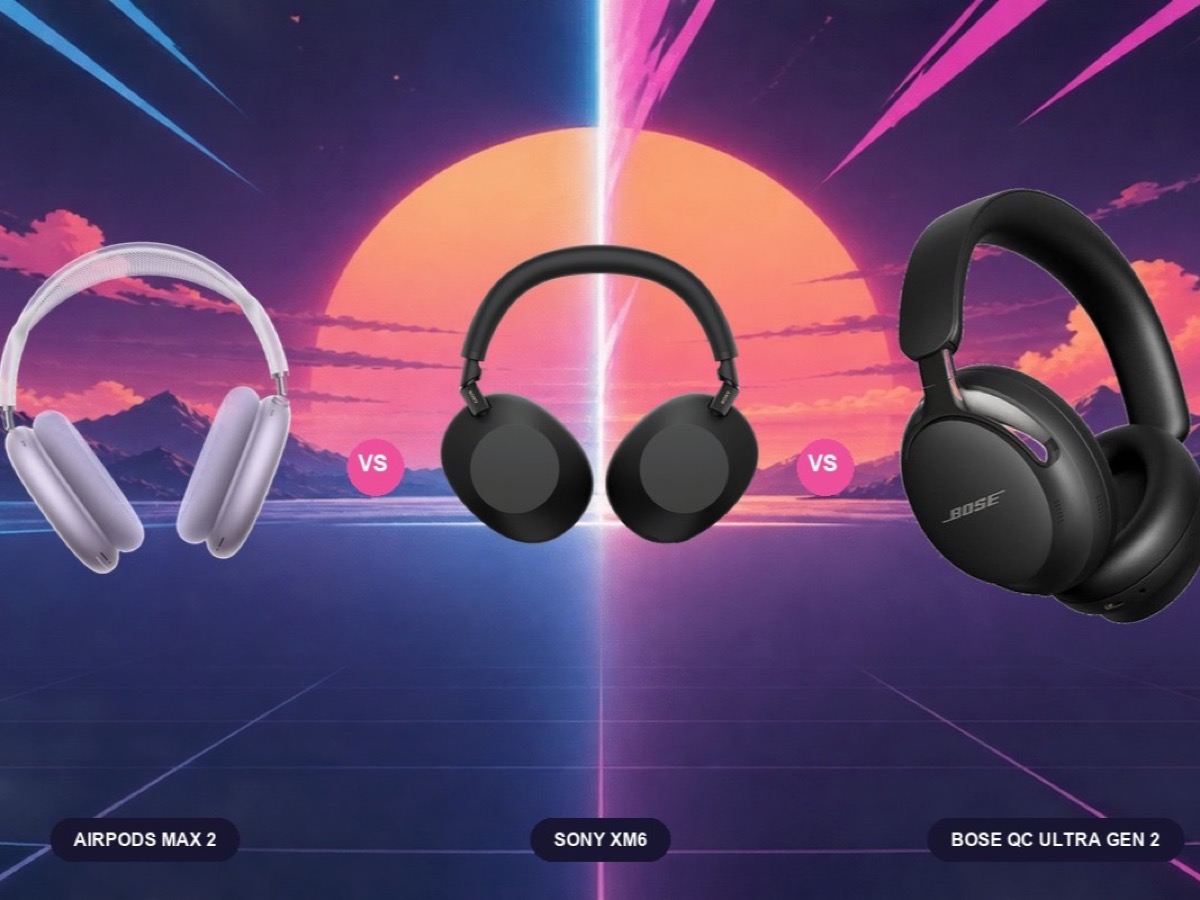
There’s a familiar trap with premium headphones: buy the one with the biggest noise-cancelling claim, or the prettiest aluminum cups, then spend the next two years wishing it were lighter, lasted longer, or worked better with your laptop. These three cost enough that the small annoyances count.
Apple’s AirPods Max 2 start at $549. Sony’s WH-1000XM6 and Bose’s QuietComfort Ultra Headphones (2nd Gen) launched at $449. All three are excellent. They’re also very clearly built around different priorities.
Our read of the evidence: Sony is the best recommendation for most people; Bose is the one to try first for frequent flyers and comfort seekers; and AirPods Max 2 make sense when Apple integration and their distinctive sound are worth a $100 premium—and the extra weight doesn’t bother you.
A quick honesty note: this is a research-led comparison, not a claim that we spent weeks wearing all three. We compared current manufacturer specifications with independent reviews and lab testing, and we link to the original work throughout. Fit, ear shape, prescription glasses and sound preference are personal; where testing disagrees, we say so.
The short answer
Buy the Sony WH-1000XM6 if you want the safest all-rounder.
They’re lighter than Apple’s, last longer than either rival on paper, work well across phone platforms, and deliver excellent sound, ANC and calls. The Bose can edge ahead in cabin hush and comfort; Sony is the more complete day-to-day package.
Buy Bose if travel comfort and quiet are the point.
The plush, light fit and formidable isolation are easy to appreciate on a long flight. Gen 2 also adds USB-C lossless listening and better battery life than its predecessor. The sound is warm and enjoyable, though some reviewers hear less detail than from Sony.
Buy AirPods Max 2 if you live in Apple’s world.
Automatic switching, spatial audio and wired USB-C lossless playback make a polished setup with iPhone, Mac, iPad and Apple TV. They sound refined and look unmistakably premium. At 386g, they’re much heavier than the others, and battery life remains 20 hours.
There isn’t a clean winner for noise cancelling. The strongest independent reviews put Sony and Bose in the top tier, and reviewers disagree about which is quieter in which conditions. Apple says Max 2 ANC improves by up to 1.5× over the previous Max, but that is Apple’s comparison against its own predecessor, not a head-to-head measurement against these two.
At a glance: the differences that count
| The detail | AirPods Max 2 | Sony WH-1000XM6 | Bose QC Ultra (2nd Gen) |
|---|---|---|---|
| Launch price (US) | $549 | $449 | $449 |
| Weight | 386 g / 13.6 oz | ~254 g / 9.0 oz | ~273 g / 9.6 oz |
| Rated battery | Up to 20 hr with ANC | Up to 30 hr with ANC; 40 hr ANC off | Up to 30 hr; 23 hr Immersive Audio |
| ANC & transparency | Adaptive Audio, Transparency | Adaptive ANC, Ambient Sound Control | Quiet, Aware, Immersive Audio |
| Wired listening | USB-C lossless audio | 3.5 mm analog; USB-C is charging, not audio | USB-C lossless; 2.5 mm analog |
| Bluetooth codecs | AAC, SBC | LDAC, AAC, SBC, LC3 | aptX Adaptive, AAC, SBC |
| Best fit | Apple households | Most people; mixed devices | Long flights, comfort, quiet |
Prices above are US launch MSRPs, not a live price feed. By September 2026, sale prices can be lower—especially for Sony, which has been on shelves longer. Check today’s retailer price before treating that $100 difference as fixed. Bose’s official battery estimate is up to 30 hours with Immersive Audio off (23 hours with it on); some independent test results vary with test setup and volume.
What matters more than the spec sheet
Noise cancelling: choose your kind of quiet
For a low, steady aircraft rumble, both Sony and Bose are exceptional. What Hi-Fi? says Bose still has a slight lead for outright sound blocking in Quiet mode, while RTINGS’ measurements rate Sony’s isolation very highly and put it ahead of the previous Bose generation. Results depend on fit, glasses, frequency and test method. The honest answer is that these are close enough to audition if flying is your main use.
Apple’s Max 2 meaningfully improves on the original, according to Apple and early reviews. But the Max remains less compelling as a value pick: you pay more, and Apple’s “1.5×” headline is a generational claim, not proof that it beats Sony or Bose in a cabin.
Sound: polished detail or a warmer blanket?
Sony is the most broadly praised for detailed, lively, spacious sound. What Hi-Fi? gives the XM6 its top marks for sound and features, praising the detail and dynamics; its review of the Bose likes the punch but says Bose is beaten for sonic transparency by the strongest rivals. That’s reviewer taste as well as performance. Bose’s warmer, bass-forward presentation is exactly what some listeners want for pop, film and low-volume travel. Its app EQ can help tailor the balance.
AirPods Max 2 have a refined, expansive presentation and are especially attractive if you use Apple Music and spatial audio. But independent reviewers are split on how much the H2 generation improves on the original sound. Apple’s smooth handoff and tightly integrated processing are part of the experience; Android users lose much of that magic.
Comfort and weight: the figure you feel all afternoon
The Max 2 weigh about 386g, around 130g more than Sony and 113g more than Bose. That’s roughly the heft of another phone on your head. The mesh canopy spreads pressure well for some people, while others find the weight and headband tiring. One person’s luxurious clamp is another person’s headache; try before buying if you’re sensitive to pressure.
Bose and Sony are both lighter and fold into a travel case. Bose gets the edge for soft padding and low-effort comfort in many reviews. Sony is also comfortable for long listening, though the firmer headband and fit may suit some heads better than others. Neither is made for running or sweaty workouts.
Battery, calls and actually carrying them
Sony rates the XM6 for 30 hours with ANC on (40 with ANC off), which makes it the endurance pick by spec. Bose rates Gen 2 for 30 hours, or 23 with Immersive Audio. Apple still rates Max 2 at 20 hours with ANC on. All three support quick charging, but topping up is still a routine Sony and Bose owners do less often.
For calls, Sony gets especially strong praise for clear voice pickup and background-noise handling. Bose is competent; Apple’s performance fits neatly into its device ecosystem. For the case, Sony and Bose fold down into conventional protective cases. Apple’s Smart Case preserves low-power standby but leaves much of the headphones exposed; the industrial design is striking, the travel solution less so.
Apple AirPods Max 2
Apple finally put its H2 chip into the over-ears, and the result is a more capable Max rather than a fundamental redesign. You get newer computational audio features, improved ANC versus the first generation, Adaptive Audio, and wired USB-C lossless audio. That wired mode also serves the ultra-low-latency crowd who make music or game.
The trick is that the Max 2’s best argument is the whole Apple setup. Automatic switching between Apple devices, hands-free Siri and personalized spatial audio feel considered in a way a Bluetooth spec table can’t show. If you move between an iPhone and Mac all day, that convenience is real. On Android they still play audio, but the premium buys much less.
The concessions are stubborn. At 386g, this is the heaviest pair here by a lot. Battery remains 20 hours, and the slim Smart Case still doesn’t fully cover the cups. Some listeners love the aluminum build and mesh canopy; some find the weight a deal-breaker. The $549 price only feels sensible when you’ll use the Apple-only perks.
Reasons to buy
- Seamless Apple device switching
- Refined sound and spatial audio
- USB-C lossless wired listening
- Premium metal construction
Reasons to think twice
- Heaviest here at about 386g
- 20-hour rated battery
- Awkward protective case
- Features and value drop on Android
For: iPhone, Mac and Apple TV users who prize integration, design and spatial audio above long battery life or a featherweight fit. Skip if: you use Android, travel constantly, or have ever returned headphones for being too heavy.
Sony WH-1000XM6
The XM6 make the most persuasive “buy one pair and stop thinking about it” case. Sony brought back a foldable design, refined the headband, improved ANC processing and call handling, and kept the XM series’ dense feature set. You get a useful equalizer, customizable controls, multipoint Bluetooth, LDAC on compatible Android devices and 30 hours of rated ANC-on battery life.
Sound is the standout in many expert reviews: lively, detailed and engaging rather than merely bassy. Noise cancelling is outstanding, voice pickup is among the best in this trio, and around 254g is an easy weight to live with. It’s the least expensive at launch, though the Bose has matched that MSRP and Sony’s street price tends to fluctuate.
There are annoyances. USB-C is for charging, not digital audio, so wired listening is analog. Sony doesn’t support aptX HD. And while the XM6 fold again, they’re still not tiny in their case. Sound can also vary more with fit and glasses than the spec sheet suggests. The good news: Sony’s app gives you plenty of control if the default tuning isn’t yours.
Reasons to buy
- Strongest all-around sound and features
- Excellent ANC and call quality
- 30 hours with ANC; lightweight
- Broad Android and iPhone usefulness
Reasons to think twice
- No lossless USB-C audio input
- No aptX HD; codec preferences vary
- Case remains fairly bulky
- Fit changes the sound for some people
For: commuters, office listeners and mixed-device households who want one capable pair for everything. Skip if: Bose’s softer fit is the priority, or you specifically want USB-C lossless audio.
Bose QuietComfort Ultra Headphones (2nd Gen)
Bose’s second generation is an evolution with a few genuinely useful fixes: longer battery life than Gen 1, lossless digital audio over USB-C, a refreshed design and smoother adaptive noise cancelling. The identity stays intact—soft, light headphones with excellent isolation, folding hinges, Quiet and Aware modes, and Bose’s Immersive Audio that adds a more speaker-like presentation for movies.
For a long flight, that combination is hard to argue with. What Hi-Fi? gives Bose a slight edge for outright cabin hush and praises comfort; RTINGS calls out strong isolation and 37-hour battery results in its particular test protocol. Do not compare that lab number directly to Bose’s rated 30-hour figure: volume, codec, ANC mode and method differ. The manufacturer’s estimate is the useful apples-to-apples spec.
The sound is warm, full and easy to enjoy, but not every reviewer hears the same clarity. What Hi-Fi? likes the fun, punchy presentation and still says it trails the best competitors for transparency. Bose’s multipoint and codecs are less universal than Sony’s. At $449, the reasons to choose Bose are comfort, silence and USB-C wired listening—not winning every spec category.
Reasons to buy
- Very comfortable, relatively light fit
- Top-tier noise isolation
- USB-C lossless and analog wired modes
- Foldable and well equipped for travel
Reasons to think twice
- Warm tuning may sound less revealing
- Immersive Audio lowers rated battery life
- Not the lightest or longest-lasting by spec
- Fit and ANC edge over Sony is close
For: frequent flyers, comfort-first listeners and people who want quiet without a heavy headset. Skip if: you want the most revealing default sound or the broadest feature set across phones.
Watch before you buy
These videos are useful for hearing the reviewers’ own priorities. A microphone sample or ANC demo watched on your speakers can’t recreate the fit or sound inside your ears, but the hands-on impressions help put the specs in context.
AirPods Max 2 — hands-on review
Sony WH-1000XM6 — review
Bose QC Ultra Gen 2 — review
So, which pair would we pick?
If you made us choose one pair for an unknown reader, it’d be the Sony WH-1000XM6. That’s not because it wins every isolated test. It’s because it combines strong sound, excellent ANC, clear calls, low weight, long battery life and platform flexibility for $100 less than Apple’s launch price.
But if “unknown reader” describes you poorly, follow the use case. Take Bose for the long-haul fit and quiet. Take Apple if your devices already share an Apple ID and you’ll use the spatial and switching features daily. Try them on if you can. Head shape isn’t a spec, and comfort is the one category where your own opinion beats ours—and the lab’s.
A few things people ask
Which headphones have the best noise cancelling?
All three are excellent. Independent reviews put Sony and Bose in the top tier, but disagree on which takes the edge depending on noise type and fit. Bose is a strong first audition for plane cabins; Sony is close and more balanced as a daily package.
Are AirPods Max 2 worth $100 more than Sony XM6?
They can be if you’re deep in Apple’s ecosystem and value seamless device switching, spatial audio and USB-C lossless wired listening. Otherwise, Sony is lighter, lasts longer on a charge, works especially well with Android and launched for less.
Which pair is most comfortable for a long flight?
Bose is the safest starting point because it’s light and generously padded, with strong noise isolation. But comfort is individual: clamp, glasses, head shape and heat all matter. Try them if you have the chance.
Can you use AirPods Max 2 with Android?
Yes, as Bluetooth headphones. But Apple-specific conveniences and features are limited, so the $549 price is harder to justify when paired with Android.
Do Bose QC Ultra Gen 2 have lossless audio?
Yes. The second-generation over-ear model supports lossless digital audio over USB-C. That is distinct from Bose’s QC Ultra Earbuds (2nd Gen), which are a separate product.
Sources & how we compared
We used manufacturer specifications for listed price, weight, battery and connectivity, then cross-checked subjective comparisons against independent product reviews and lab testing. We don’t treat a brand’s “best ever” claim as a direct comparison, and we don’t present forum anecdotes as measured facts.
- Apple: AirPods Max 2 product details and technical specifications (weight, battery, USB-C and features).
- What Hi-Fi?: AirPods Max 2 review (March 31, 2026).
- Sony: WH-1000XM6 details; What Hi-Fi? review; RTINGS lab review.
- Bose: QuietComfort Ultra Headphones (2nd Gen); What Hi-Fi? review; RTINGS lab review.
- Tom’s Guide: AirPods Max 2 vs Sony XM6 and SoundGuys: AirPods Max 2 vs Bose QC Ultra Gen 2.