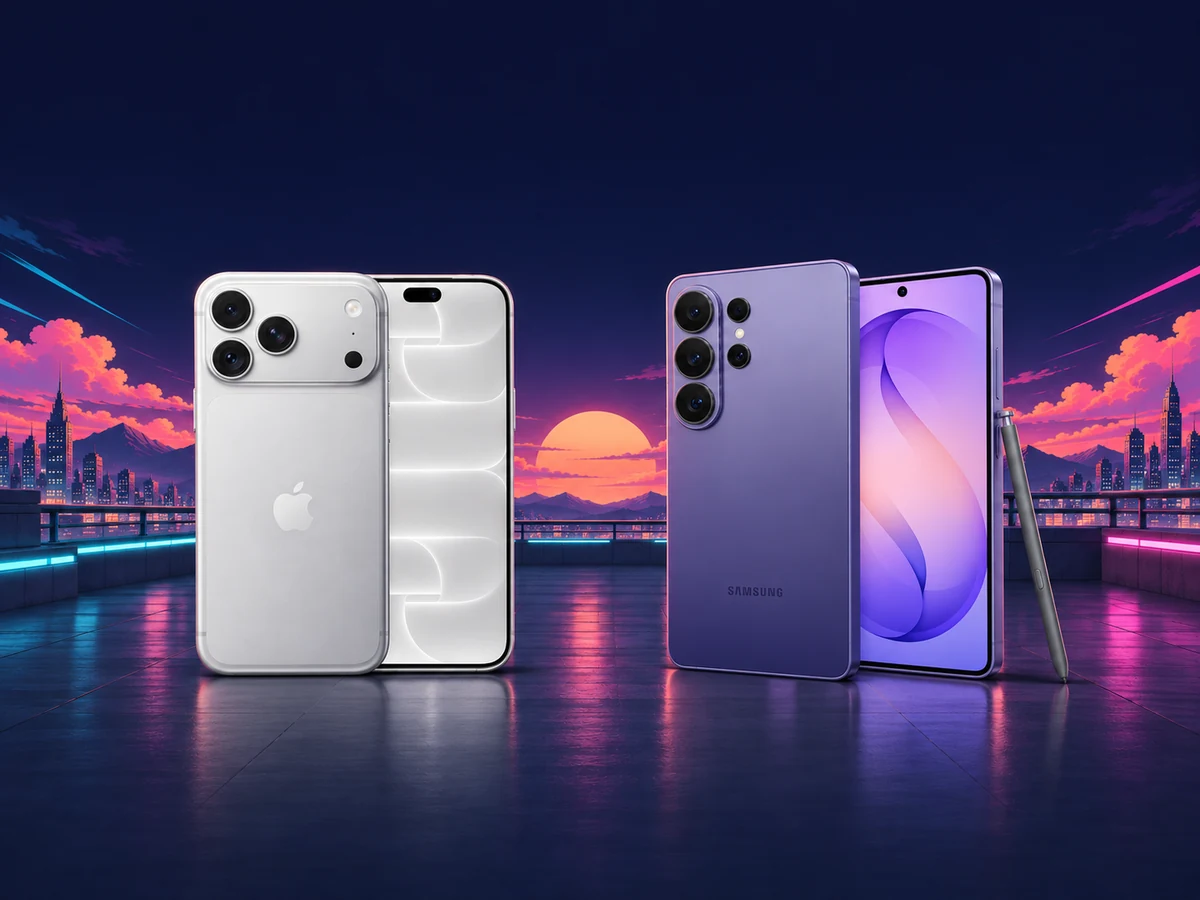
Research-based comparison, checked November 9, 2026. We have not tested these phones ourselves. Specifications come from the manufacturers; lab results are attributed to the publications that measured them. The buying framework and cost examples are our analysis. Sources, AI assistance and editorial policy.
Our verdict: choose the advantage you will use on an ordinary Tuesday
The iPhone 18 Pro Max is our stronger starting point for someone already comfortable with an iPhone who wants more endurance between charges. Two independent comparisons favor it for battery life. The Galaxy S26 Ultra makes a more specific argument: a built-in pen, a configurable Privacy Display and a desktop-style workspace through Samsung DeX. Those capabilities can change how you work, provided you actually have a use for them.
That last qualification decides more than a specification leaderboard. A feature used twice a year rarely compensates for a nuisance repeated twenty times a day. A train commuter may value charge remaining at dinner; someone annotating documents may care more about reaching for a pen. Neither person needs to adopt the other’s definition of the best phone.
Which are the latest iPhone and Samsung Galaxy models?
As of November 9, Apple’s current Pro family is iPhone 18 Pro and iPhone 18 Pro Max; its standard lineup still includes iPhone 17. Do not assume an ordinary “iPhone 18” exists just because the Pro generation has advanced. Samsung’s current S flagship family is Galaxy S26, S26+ and S26 Ultra. See the live Apple lineup and Samsung S26 Ultra page.
| Your priority | Apple starting point | Samsung starting point |
|---|---|---|
| Large conventional flagship | iPhone 18 Pro Max | Galaxy S26 Ultra; the main comparison below |
| A smaller conventional phone | iPhone 18 Pro; compare iPhone 17 if price matters more than Pro features | Galaxy S26; compare the actual size and price rather than treating it as the same tier as an iPhone Pro |
| A larger screen that folds open | iPhone Duo | Galaxy Z Fold8 or Fold8 Ultra |
| A phone that folds smaller in a pocket | Check whether a conventional iPhone meets the size requirement | Galaxy Z Flip8; a different purpose from a book-style foldable |
Samsung’s Fold8 and Flip8 announcement establishes those distinct formats. An unfolding workspace and a smaller closed phone solve different problems. Our iPhone Duo guide explores the larger-workspace question; this article concentrates on the two large, conventional flagships.
iPhone 18 Pro Max vs Galaxy S26 Ultra at a glance
| Decision point | iPhone 18 Pro Max | Samsung Galaxy S26 Ultra |
|---|---|---|
| 256GB starting price | $1,299 | $1,299.99 |
| Display | 6.9-inch OLED; refresh rate up to 120Hz | 6.9-inch AMOLED; adaptive 1–120Hz |
| Weight without a case | 249g | 214g |
| Chip | A20 Pro | Snapdragon 8 Elite Gen 5 for Galaxy |
| Rear camera arrangement | 48MP main with variable aperture, 48MP ultrawide, 48MP 4× telephoto | 200MP main, 50MP ultrawide, 10MP 3× and 50MP 5× telephotos |
| Distinctive buying reason | Independent endurance results, plus continuity for an existing iPhone routine | Built-in S Pen, Privacy Display and Samsung DeX |
Primary references: Apple technical specifications, Apple’s price announcement and Samsung’s specifications and pricing. Screen diagonals are nominal measurements; rounded corners reduce usable area.
The Galaxy is 35g lighter, calculated from those listed weights. That difference deserves a shop visit: hold each with a realistic case and try your usual one-handed actions. A screen-size tie does not mean a comfort tie. If you support a phone with a little finger while reading, weight may matter more often than an occasional benchmark win.
The real price difference is in the deal, the plan and the switch
At matching starting list prices, the gap is just 99 cents. That cannot sensibly settle a purchase this large. Compare the offers you can actually use, with the same storage and the same period of ownership.
Our practical calculation is: phone + required accessories + extra service costs over your chosen term + necessary switching replacements − trade-in or net resale proceeds. Count your old phone once: either trade it in or sell it. A watch or accessory you can keep using is not a switching expense; something you must replace to retain an essential function is.
Here is an illustrative example, not a current carrier offer. A promotion saves $200 on a phone but requires a plan costing $15 more each month than your acceptable alternative. Over 36 months, that plan adds $540. The apparent saving becomes $340 in additional total cost. Bill-credit timing, early payoff rules and the length you actually keep the plan can change that calculation.
Storage belongs in this decision too. Open your existing phone’s storage settings before ordering. Someone already managing a nearly full device should price the next capacity on both sides; someone with plenty of space should not buy extra storage merely because it is offered. Leave uncertain future resale values out of the base case, then treat them as a separate scenario.
The better camera depends on the photograph you keep missing
Megapixels describe a part of the imaging system, not the odds of getting the picture you wanted. For a buyer photographing children indoors, a sharply rendered distant sign may be almost irrelevant. For someone recording a stage from the back of a venue, reach and stabilization become central. Decide which failure you are trying to reduce before comparing attractive samples.
Apple’s variable main-camera aperture adds control over light and depth of field. That is a reason to explore its camera controls if you enjoy making those choices; it does not establish that automatic snapshots always look better. Samsung supplies dedicated 3× and 5× telephoto cameras, giving it different framing options. Neither arrangement lets us declare a universal camera winner from a table.
Read zoom labels carefully. Apple’s 8× “optical-quality” setting is not a separate 8× lens. Samsung likewise distinguishes its 3×/5× optical positions from 2×/10× optical-quality settings. Both manufacturers explain the distinction in the specifications linked above. A bigger advertised zoom number is not proof of more retained detail at the distance you use.
A more useful camera comparison
- Pick three recurring scenes. For example: a moving person indoors, a backlit face outside and a distant subject at the framing you normally want.
- Compare matched samples. Use the same scene and approximate framing from an independent comparison, not unrelated promotional galleries.
- Judge the final use. Look at faces, motion and legibility at the size you share or print. Inspect detail closely when it affects your use, rather than automatically rewarding the sharpest crop.
- Check the work around the capture. Consider editing, exporting and delivering a video in your required app. A good result that adds several unwanted steps can still be the wrong tool.
Tom’s Guide’s matched comparison and PhoneArena’s comparison provide independent material to inspect. We have not taken our own comparison photographs. Our recommendation is to choose the camera that addresses your repeated disappointment, rather than borrowing another reviewer’s overall category winner.
Battery evidence favors iPhone; charging needs a separate question
These independent results point in the same direction for endurance. Keep each publication’s pair together: different test procedures produce different absolute hours.
| Published test | iPhone 18 Pro Max | Galaxy S26 Ultra |
|---|---|---|
| Tom’s Guide battery-drain test | 18h 27m | 16h 40m |
| PhoneArena browsing test | 29h 38m | 20h 10m |
| PhoneArena full wired recharge | 68 minutes | 49 minutes |
Sources: John Velasco, Tom’s Guide, September 19; PhoneArena comparison, updated October 14. Do not average the browsing result with the other publication’s drain result, or compare them directly with manufacturer video-playback claims.
Charging is less tidy: Tom’s Guide reports 80% versus 77% after 30 minutes in Apple’s favor; PhoneArena reports 71% versus 78% in Samsung’s favor. Those results do not support one universal short-charge winner. Hardware variants, adapters, starting conditions and procedures can matter; the articles do not establish which factor explains this disagreement.
Our buying judgment: give the iPhone’s endurance evidence more weight if you regularly go long stretches without a socket. If you routinely recharge from low to full, PhoneArena’s Samsung result is relevant. If your habit is a brief top-up, verify the charger and conditions that match your routine. Apple’s fast-charge claim specifically calls for compatible 60W-or-higher AVS power hardware and a suitable cable; a wattage printed on an old adapter is not the whole check. Consult Apple’s charging conditions and Samsung’s current charging requirements before budgeting accessories.
Samsung’s extra tools earn their place only when they remove work
S Pen: a reason to choose, if you reach for a pen
A built-in stylus is a concrete distinction for marking up documents or making handwritten notes. The useful test is whether you will use it in the apps and file formats you already depend on. Do not budget it as a remote camera button: Samsung’s S26 Ultra S Pen guidance says this pen does not support Bluetooth Air Actions.
Privacy Display: viewing-angle control with limits
Samsung’s Privacy Display instructions describe enabling and configuring its protection, including selected apps or notifications. That may be valuable when you repeatedly read sensitive information beside other people. It does not make an unlocked phone safe to hand over or protect every route by which data can leave it. Check whether the enabled display remains comfortable for your own viewing position.
DeX: check the actual desk you want to replace
Samsung DeX can provide a desktop-style workspace on a compatible external display. That is a practical differentiator for someone who already carries the phone but sometimes needs a bigger work surface. Price the display connection, input devices and any app limitations. Samsung distinguishes this from DeX on PC, which is not supported on the S26 series. Samsung’s DeX compatibility guidance.
A sensible trial is one complete document task: open the file, make the required edits, attach it and send it through your real work account. A desktop-looking interface is useful when that sequence succeeds. The presence of a video-output port on another phone does not establish an equivalent workspace.
AI: test the request, its permissions and its price
Ask each phone to help with the same recurring task, using your actual language, account type and supported apps. Check the result before acting on it. A polished demonstration of a restaurant search says little about whether your work calendar, document or messaging app participates in the same workflow.
Also read the terms for the feature you expect to keep. Samsung distinguishes basic Galaxy AI features from enhanced or third-party services with separate conditions in its launch footnotes. Apple’s Intelligence usage guidance describes feature-specific limits. Neither an AI badge nor today’s included access is a complete long-term cost estimate.
Before switching brands, audit the things you touch every day
Make a short inventory: watch, car connection, authentication apps, passwords, payment cards, family features, photo storage and any indispensable work app. Verify support for the exact replacement device and region. The cost of switching is not just replacing hardware; it includes finding a workable routine for something that used to be automatic.
Separate that practical cost from brand loyalty. If a phone gives you a meaningful improvement every day, learning new menus may be worth it. If the attraction is one occasional feature, rebuilding several dependable habits can consume the benefit. We would switch for a recurring advantage we can demonstrate, rather than an expectation that everything will feel better once the migration is over.
For long ownership, Samsung promises seven generations of OS upgrades and seven years of security updates from the global launch date. The clock does not restart when you buy the phone. Do not convert a manufacturer’s update policy into a prediction about battery condition or every future app’s compatibility. We have not assumed an identical fixed-term Apple commitment.
Which one should you buy?
Choose iPhone 18 Pro Max if…
- You value the independent endurance advantage and often charge late.
- Your existing iPhone routine works well, and you want to preserve it.
- You have inspected relevant camera samples and prefer its results or controls.
Choose Galaxy S26 Ultra if…
- S Pen, Privacy Display or DeX solves a recurring problem you can name.
- You prefer its lighter listed weight after trying the grip with a case.
- Your required apps, accessories and purchase offer make the complete switch worthwhile.
Choose a smaller or less expensive model if neither phone’s size and capabilities fit your day. A costly flagship is poor value when its main contribution is making the same tasks heavier to carry. For another conventional-phone option, see our iPhone 18 Pro vs Pixel 11 Pro comparison. Browse the phone buying guides for other formats.
Frequently asked questions
What are the latest iPhone and Galaxy flagships?
As of November 9, 2026, Apple’s conventional Pro flagships are iPhone 18 Pro and iPhone 18 Pro Max. Samsung’s current S flagship series is Galaxy S26, S26+ and S26 Ultra. Both brands also offer foldables, which solve different size and workspace needs.
Is iPhone 18 Pro Max or Galaxy S26 Ultra better for battery life?
Tom’s Guide and PhoneArena both report longer endurance for iPhone 18 Pro Max in their respective tests. Their absolute hours use different methods and should not be combined. Your runtime depends on usage, settings, signal and battery condition.
Which phone has the better camera?
There is no universal winner established by specifications alone. Apple adds a variable-aperture main camera; Samsung has dedicated 3× and 5× telephotos. Compare matched examples of the subjects and framing you use, including motion and video workflow.
How much do the 256GB versions cost?
The U.S. starting list prices checked November 9, 2026 are $1,299 for iPhone 18 Pro Max and $1,299.99 for Galaxy S26 Ultra, before tax. Current offers, storage choices, trade-ins and required plan costs can change the total.
Does Galaxy S26 Ultra support Samsung DeX on PC?
Samsung says DeX on PC is not supported on the S26 series. A DeX workspace on a compatible external display is a separate capability; check its connection and app requirements.
Have you tested these phones yourselves?
No. We researched manufacturer documentation and attributed independent comparisons. The cost arithmetic and buying framework are our editorial analysis, not original laboratory or hands-on results.
Sources and method
- Apple — current iPhone lineup.
- Apple — Pro/Pro Max specifications and charging conditions.
- Apple — September 9 announcement and U.S. starting prices.
- Apple Store — exact-model source photography.
- Samsung — current S26 Ultra product information and photography.
- Samsung — February 25 specifications, starting prices and update-policy footnote.
- Tom’s Guide — John Velasco’s September 19 comparison.
- PhoneArena — Peter Kostadinov and Orhan Chakarov; comparison updated October 14.
- Samsung Support — Privacy Display, S Pen and DeX compatibility.
Research checked November 9, 2026. Our contribution is a use-frequency decision framework, matched-price and carrier-cost arithmetic, a camera evaluation checklist and an interpretation of conflicting charging evidence. We do not average unlike tests, invent review scores, claim owner consensus or imply hands-on work. AI assisted writing, production and artwork; manufacturer photography identifies the products. No affiliate links. Editorial policy · Send a correction.